11+ Practice Questions (With Answers): Try Real Exam-Style Questions

If your child is preparing for the 11+ exam, one of the most effective ways to improve is through realistic practice questions.
Many pupils are familiar with maths and English from school, but verbal reasoning (VR) and non-verbal reasoning (NVR) can feel completely new. Even within familiar subjects, the format and difficulty of 11+ questions can be surprising.
In this guide, we’ve included a selection of 11+ practice questions with answers, covering:
- English
- Maths
- Verbal Reasoning
- Non-Verbal Reasoning
These are designed to reflect the types of questions your child is likely to encounter in exams such as the Kent Test and other 11+ assessments.
English Practice Questions
Question 1: Spelling
In the sentence below, there is either one spelling mistake or no mistake.
The employer consistently acknoledged the employee’s dedication.
Which group contains the mistake?

Answer:
👉 C) “acknoledged”
Explanation:
The word is incorrectly spelt. The correct spelling is “acknowledged”.
Question 2: Sentence Completion
Sarah thought about all the days she ______ out there, toiling away.
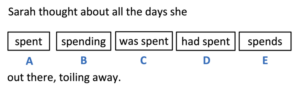
A) spent
B) spending
C) was spent
D) had spent
E) spends
Answer:
👉 D) had spent
Explanation:
The sentence is written in the past tense and refers to something that happened before another past moment. This requires the past perfect tense (“had spent”).
Maths Practice Questions
Question 1: Shape Reasoning
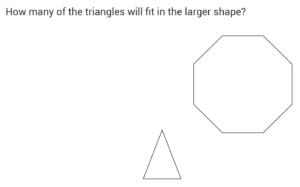
How many of the triangles will fit into the larger shape?
Answer:
👉 8
Explanation:
The larger shape is a regular octagon, which can be divided into 8 equal triangular sections.
Question 2: Time and Distance
I drive from 10:45 until 12:15 at an average speed of 60 mph.
How far do I travel?
A) 80 miles
B) 90 miles
C) 120 miles
D) 100 miles
E) 105 miles
Answer:
👉 B) 90 miles
Explanation:
Time travelled = 1.5 hours
Distance = speed × time = 60 × 1.5 = 90 miles
Verbal Reasoning Practice Questions
Question 1: Letter Transfer
Move one letter from the first word to the second word to make two new words.
house → clod
Answer:
👉 u
Explanation:
- Remove “u” from house → hose
- Add “u” to clod → cloud
Both are valid words.
Question 2: Word Meaning
Find two words, one from each group, that are closest in meaning.
Group 1:
- serious
- carnival
- malicious
Group 2:
- benevolent
- careful
- spiteful
Answer:
👉 malicious and spiteful
Explanation:
Both words mean having or showing a desire to cause harm or distress.
Non-Verbal Reasoning Practice Questions
Question 1: Shape Analogy
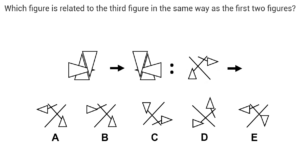
Which figure completes the sequence?
Answer:
👉 Figure A
Explanation:
The second figure is a reflection of the first across a vertical line. Applying the same transformation gives Figure A.
Question 2: Shape Coding
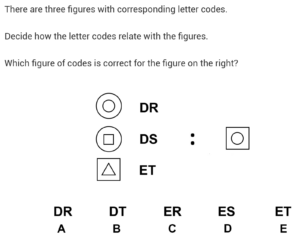
Which code matches the shape?
Answer:
👉 ER
Explanation:
- First letter = outer shape (E = square)
- Second letter = inner shape (R = circle)
Why Practice Questions Matter for the 11+
Practising questions like these helps children:
- Become familiar with question styles
- Improve speed and accuracy
- Build confidence with unfamiliar topics like reasoning
Many pupils struggle not because of ability, but because they haven’t seen these question types before.
Practising Effectively for the 11+
The most effective preparation combines:
- Strong maths and English foundations
- Regular reasoning practice
- Timed exam-style tests
At White Dot Education, we provide structured 11+ practice designed to mirror real exam conditions across multiple consortia, including:
- Kent
- Bexley
- Buckinghamshire
- Slough
- South West Herts
Our platform allows students to:
- Practise realistic questions
- Sit full-length mock exams
- Receive instant feedback
- Track progress over time
Final Thoughts
The 11+ exam tests more than just knowledge — it tests how well a child can apply their skills under pressure.
By practising a wide range of question types, children can develop:
- confidence
- familiarity
- exam technique
If your child is preparing for the 11+, consistent practice with high-quality questions can make a significant difference.